AI Influencer Realism Scorecard: A 20-Point Audit for Images and Video
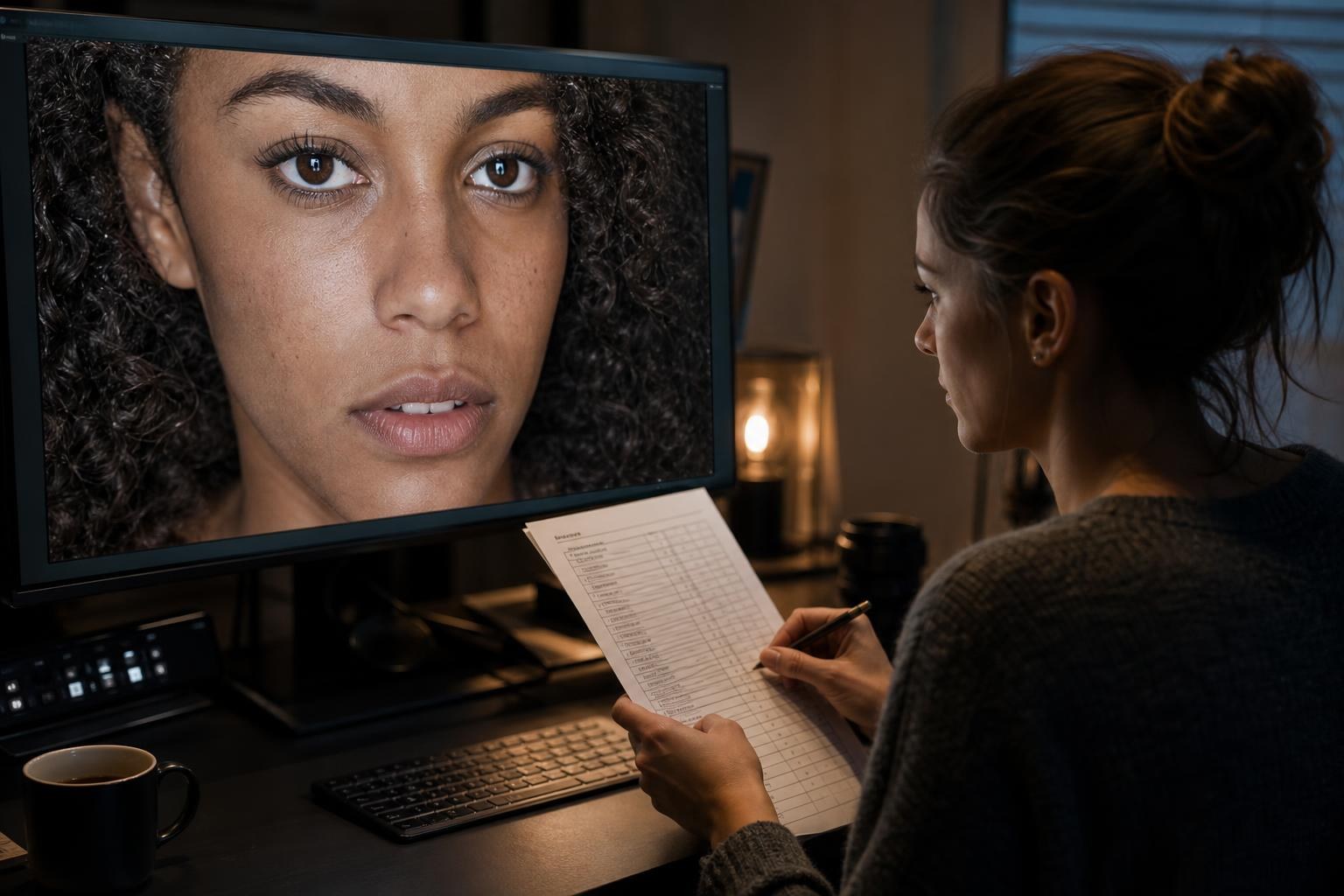
A realistic AI influencer passes a structured audit, not a glance. Score every image or clip against 20 pass/fail checks covering identity, skin and eyes, light and lens behaviour, hands and backgrounds, and motion. Then run a separate disclosure check before you publish.
This scorecard is built to be copied into a doc, pinned to a wall or pasted into an approval workflow. Cite it, adapt it, share it with your team.
Why your eyes are not the test
Most realism advice assumes you can judge quality by looking. The research says otherwise.
What the research says about spotting AI faces
- In Miller et al. (Psychological Science, 2023), White AI faces were judged human more often than real White faces. The effect did not appear for non-White faces, and the least accurate participants were the most confident, according to the British Psychological Society's digest. The main new experiment had 124 participants. The ANU repository holds the record.
- Nightingale and Farid (PNAS, 2022) reported that AI-synthesised faces were indistinguishable from real ones and rated more trustworthy. Check the paper itself before quoting specific percentages.
- A 2024 University of Waterloo study, reported by PetaPixel, found 61% accuracy on 20 mixed images, against the 85% the researchers expected.
- Live Science reports that a brief training session lifted scores for both "super-recognisers" and typical viewers.
The takeaway is practical. A single face is easy to pass. Realism breaks down across a set of images, in hands, in physics and in motion. That is where a scorecard earns its keep, and it is why reviewers should work from criteria rather than confidence.
The 20-point realism scorecard
Mark each item Pass or Fail. No half marks. If you cannot decide, it is a Fail.
A. Identity and consistency (1–4)
- Face match. Compare against your reference set at full size. Jawline, nose, eye spacing and brow shape should match the approved identity.
- Body and proportion. Height, shoulders, hips and limb length should stay stable between posts, not drift with the prompt.
- Signature details. Moles, freckles, hairline, tooth shape and any tattoos should appear where they always appear.
- Age and styling continuity. Hair colour, length and makeup should make sense for the timeline of the content.
B. Skin and eyes (5–8)
- Pore-level texture. Zoom to 100%. Skin should show fine, irregular texture, not a uniform airbrushed sheen.
- Tonal variation. Look for natural shifts in colour across nose, cheeks, forehead and neck. Flat, even tone reads as rendered.
- Eyes. Catchlights should match the light source and sit in both eyes consistently. Pupils should be the same size and gaze should have a clear target.
- Teeth, lips and brows. Individual teeth, a believable lip edge and brow hairs that follow growth direction.
C. Light and lens behaviour (9–12)
- One coherent light logic. Shadows, highlights and reflections must agree on direction and softness.
- Plausible depth of field. Blur should increase gradually with distance, as it would on a real lens, not cut out around the subject like a mask.
- Lens character. Perspective should suit the implied focal length. A close portrait that looks like it was shot wide, or a "phone snap" with studio-perfect rendering, is a tell.
- Colour and grain. Noise, white balance and contrast should look like one capture, not several stitched together.
D. Hands, backgrounds and edges (13–16)
- Hands and fingers. Count them. Check joints, nail shape and how fingers wrap around objects.
- Contact and weight. Objects should rest, grip and press with believable pressure. Check the fabric where it meets skin.
- Background logic. Signs, text, architecture and furniture should make sense at full zoom. Warped lettering is an instant fail.
- Edges and hair. Look for halos, smeared boundaries and hair strands that merge into the background.
E. Motion and audio (17–20)
For still images, score these N/A and judge out of 16.
- Lip sync. Mouth shapes should match the phonemes, including the closed lips on "b", "m" and "p".
- Blink and micro-movement. Blinks, small head shifts and breathing should be present and irregular, not looped.
- Physics. Hair, clothing, jewellery and liquids should move with weight and follow the body's movement.
- Temporal stability. Scrub frame by frame. Face, skin texture, hands and background should not flicker, morph or crawl.
How to score it
This scoring rule is our suggested standard, not an industry benchmark. Adjust it to your risk level.
| Result | Score | Action |
|---|---|---|
| Publish | 18–20 of 20 (or 15–16 of 16 for stills) with no critical fails | Approve and log |
| Rework | 14–17 | Fix the failed items and re-score |
| Reject | Below 14, or any critical fail | Regenerate from scratch |
Treat items 1, 7, 13, 15 and 20 as critical. A wrong face, dead eyes, broken hands, garbled text or flickering motion is a reject, whatever the total.
Common mistakes
- Reviewing one image in isolation. Always review against the reference set. Most identity drift only shows up side by side.
- Over-polishing. Smoothing out every imperfection removes the texture that makes a face credible. Keep controlled, believable imperfection: uneven skin, flyaway hair, slightly off-centre framing.
- Faking flaws. The opposite error. Stamped-on blemishes and random grain look worse than clean output. Imperfection should follow the light and the lens.
- Zooming too little. Check at 100%, then at the size it will actually be viewed. Both matter.
- Judging video from a thumbnail. Motion artefacts live between frames. Watch at full speed, then step through.
- Letting the creator self-approve. The person who made the content is the worst-placed to see its flaws.
- Skipping the disclosure check. A flawless image can still be non-compliant.
The disclosure check (separate from realism)
Realism and disclosure are different questions. The more convincing your content, the more the second one matters. This is general information, not legal advice. Confirm the details with counsel and primary sources.
EU: Article 50
According to a practical guide to Article 50, the transparency obligations apply from 2 August 2026. Deployers must disclose that deepfake content is AI-generated or manipulated. The duty is reduced, not removed, for evidently artistic, creative, satirical or fictional works. The same page says systems already on the market have until 2 December 2026 for machine-readable marking.
A deepfake is defined as content resembling existing persons, objects, places, entities or events that would falsely appear authentic. A wholly fictional character resembling no real person may fall outside that definition, but that reading depends on the Commission's guidelines. GT Law's commentary discusses those guidelines. We have not verified the detail against the Commission's own site, so check there.
US: FTC endorsement rules
Law-firm commentary says the FTC's revised Endorsement Guides (2023) cover virtual endorsers, and the same disclosure rules apply as for human ones. Baker Law and Infolaw Group both set this out. Failing to disclose that an endorser is virtual can be a problem when viewers might reasonably believe they are real. These are law-firm summaries, so read ftc.gov before relying on them.
China: labelling Measures
The AI content labelling Measures took effect on 1 September 2025. They require visible labels and embedded metadata labels, and distribution platforms must check for the embedded ones. See HSF Kramer and Loeb & Loeb.
UK: no virtual-influencer-specific rule found
In its 2022 response to a parliamentary committee, the ASA said it had received no complaints about virtual influencers and knew of no research showing advertising harm. It declined to require watermarking, and would apply any such rule only to advertising. The committee published the responses. We found no UK rule aimed specifically at virtual influencers, but general ad and influencer disclosure rules still apply. That response is from 2022, so check current guidance.
Platform labels
Meta, YouTube, TikTok and others each run their own AI labelling settings, and they change often. We have not covered them here. Check each platform's current policy before every campaign.
Likeness and consent
A fully synthetic persona and a persona built from a real person's photos are different risks. Using a real person's likeness as the base can bring the content within the deepfake definition above, and raises consent and rights questions. Build identities from original, licensed or fully synthetic sources, and keep records of where they came from. Hyper Realism Club's licence terms set out what commercial usage a Marketplace licence covers.
Agencies and brands: who signs off
Intermediaries can share responsibility for disclosures, so build the check into your process rather than leaving it to the creator.
- Name a reviewer who did not produce the asset.
- Keep the reference set with the approved identity images and a short style note.
- Log every score, with date, version, reviewer and failed items.
- Record the disclosure decision and the label or caption used.
- Re-audit periodically. Models update, and identity drift creeps in over time.
For brand teams, add the scorecard to your internal approval guidelines as a gate between "generated" and "scheduled".
Building to pass the audit
Most failures trace back to the pipeline, not the final polish. A well-trained identity, a controlled image workflow and a disciplined video pipeline remove problems before review. At Hyper Realism Club, that is the focus of the custom LoRA identity builds and the production workflows, and the course teaches the process end to end. If you would rather start from a finished identity, Marketplace models are one-of-one licences priced from 74.99 to 119.99 USD, one-off, and are removed from sale once purchased. Browse the Marketplace if that suits your plan.
Whichever route you take, run the scorecard on the output. A tool or a model does not replace the audit.
Frequently asked questions
Do I have to label a fully fictional AI influencer?
It depends on where you publish and what the content does. EU Article 50 targets deepfakes that resemble existing persons and would falsely appear authentic, and whether a wholly fictional character falls inside that depends on the Commission's guidelines. US commentary says disclosure can matter when viewers might reasonably think an endorser is real. Take legal advice for your markets.
Does an AI influencer need a "virtual" label on every post?
There is no single global rule. Requirements vary by jurisdiction, platform and whether the post is advertising. Where a post is a paid endorsement, or could mislead viewers about the endorser being real, labelling is the safer course.
Can I use a real model's photos as a base?
Only with clear consent and the right permissions. Using a real person's likeness can bring content within the EU deepfake definition and raises separate consent and rights issues. A fully synthetic or properly licensed identity is a lower-risk starting point.
What score should an image need to pass?
We suggest 18 of 20 for video, or 15 of 16 for stills, with no fails on the five critical items. That threshold is our own recommendation, not an industry standard, so tighten it for high-risk campaigns.
How often should I re-audit an AI influencer?
Re-score a sample of recent posts regularly, and whenever you change models, workflows or settings. Identity drift often appears gradually, so compare new content against the original reference set.
Sources
- The EU AI Act's Transparency Rules: A Practical Guide to Article 50
- GT Law: European Commission details transparency obligations under the AI Act
- Baker Law: Updated FTC Endorsement Guides Hold Virtual Influencers to Actual Standards
- Infolaw Group: Virtual Influencers Are Now Officially Regulated Endorsers
- HSF Kramer: China Releases Laws to Mandate Labelling of AIGC
- Loeb & Loeb: China's AI Labeling Measures Take Effect September 1
- ASA: System response to the DCMS Committee influencer report
- UK Parliament: DCMS Committee publishes responses from CMA and ASA
- British Psychological Society Research Digest: AI faces seem realer than real
- Miller et al., Psychological Science, 2023 (ANU repository)
- Nightingale & Farid, PNAS, 2022 (PMC)
- PetaPixel: 40% of People Can't Tell if a Face is AI Generated
- Live Science: Do you think you can tell an AI-generated face from a real one?
Want an AI influencer that's yours alone?
Browse the Marketplace